PO Box 759
Braeside 3195
VIC AU
Tel (61 3) 9587 5511
Fax (61 3) 9587 6457

The manufacture of Tools and Dies has become a more difficult task than ever before. The dies are more intricate, larger and the production quantities more demanding of the Toolmaker than ever before. Lead times for delivery have been compressed to such an extent that welding has become an integral part of the tool and die manufacturing process.
Imagine having a facility available that will enable you to replace missing tool steel, regardless of whether you have removed too much in machining, the tool has worn or your client has modified his original requirement. Imagine having a welder at your disposal that understands toolmaking and all the constraints that face you every day. Imagine having a welder that understands the metallurgy of tool steels and can give you exactly what you want. Imagine having a welder that understands ‘just in time’ and the urgency of your particular problem.
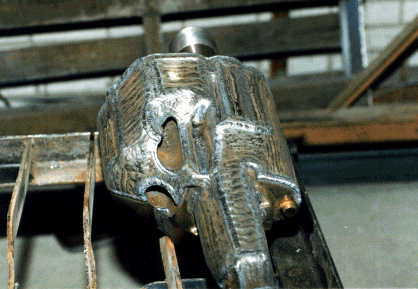
A H13 core for a gearbox extension housing required modifications. This required a weld deposit of 3mm over 50% of the die casting area. Click image to enlarge!
The oldest profession in the world is Toolmaking. Cavemen revered the clan chief, the medicine man and the toolmaker. Stone, such as flint was used and excess material was removed until the required tool was made. If too much was removed, the tool was set aside for some other use, (a knife became a scraper) or it was thrown away. When the art of joining things together was developed, (a technique used only by mankind) toolmakers made tools with handles such as spears and axes. In the 1950's, tools were made by nesting inserts into a holder block. With the advent of the E.D.M. and Copy Mills, we have gone back to the original method of making tools by removing excess material. It’s just a little more difficult to throw away a modern tool or die than a lump of flint! What it means is that your biggest problem is a lack of material. To put it simply, we can replace it.
The technology in toolmaking is advancing very quickly. As new materials and techniques are developed, we are researching new processes to enable us to service your requirements.
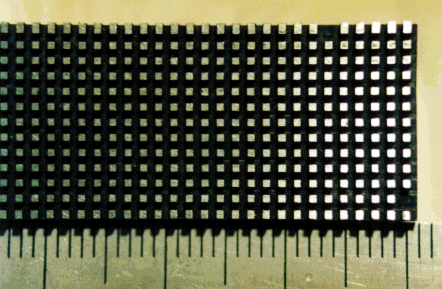
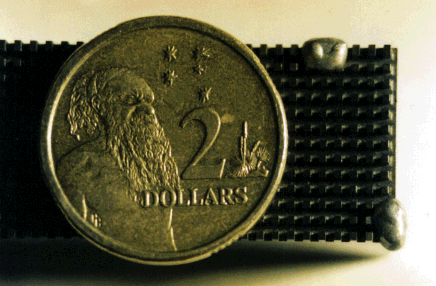
These photographs shows a core from a die. It molds a fine filter mesh for a dish washer. Base material is Thyssen 2379 hardened to 60 HRC. The areas broken can be measured against the metric rule showing 1mm graduations. The $2 coin is 20mm (3/4 inch) in diameter.
Click image to enlarge!